
Benefits of adding carbon labels to your menus
Key takeaways
- The average UK meal produces around 1.7kg of CO2e, more than three times the Paris Agreement's target of under 0.5kg per meal.
- Carbon labels can educate customers and catering teams, meet growing consumer demand for transparency, support CSR goals, and give hospitality businesses a competitive edge.
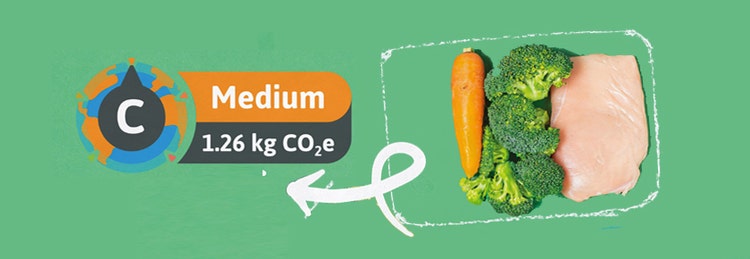
- Avendra International's Pi eProcurement system calculates an indicative CO2e value for each dish using data from the World Resources Institute and the Poore & Nemecek (2018) Science study, displaying low, medium and high carbon labels.
- CO2e labels can be included on recipe specification sheets alongside costing, allergen, nutrition and calorie information, and shared with customers via QR code through The Food Checker tool, available through the Pi platform.
Why carbon labelling matters: UK meals and the Paris Agreement target
The average carbon dioxide equivalent (CO2e) emissions of a UK meal are estimated to be 1.7kg – this exceeds the Paris Agreement’s target of <0.5kg per meal by more than three times!
Many hospitality businesses are increasingly aware of their environmental impact and are committed to reducing their carbon footprint. Adding carbon labels to your menu is one way to support the fight against climate change.
4 benefits of adding carbon labels to your menu
1. Educate teams and customers on carbon impact
By providing information about the carbon emissions associated with each dish, companies can raise awareness about the climate impact of food production and consumption. Carbon labels guide customers’ food choices and encourage behavioural changes. And the catering team can use this as a tool to help them adjust their recipes to lower carbon dishes – both are crucial for reducing CO2 levels.
2. Meet growing consumer demand for transparency
There is growing consumer demand for transparent and eco-friendly dining options. Customers are becoming more conscious about their carbon footprint and want to make informed choices regarding their food.
3. Support corporate social responsibility goals
Adding carbon labels to your menus can demonstrate your organisation’s environmental responsibility and promote sustainable practices within the industry.
4. Gain a competitive edge on sustainability
With the rising interest in sustainable practices, incorporating carbon labels can help catering and hospitality businesses differentiate themselves from competitors and attract new environmentally conscious consumers.
What is CO2e (carbon dioxide equivalent) value?
CO2e stands for carbon dioxide equivalent. It is a metric that measures and expresses the global warming potential of different greenhouse gases relative to carbon dioxide (CO2). Since various greenhouse gases have different heat-trapping abilities and lifetimes in the atmosphere, expressing their impact on CO2e allows for a standardised comparison.
In food service, CO2e is a way to measure how much greenhouse gas is released during the production, transportation, and disposal of different types of foods. CO2e measurement identifies which foods have the most significant environmental impact and where we should concentrate our efforts to support sustainable food production and consumption.
Net zero 2050: what it means for food carbon footprints
The net-zero targets for CO2e emissions are becoming increasingly important as the world seeks to limit global warming to 1.5°C above pre-industrial levels by around 2050.
To achieve a net zero target for CO2e emissions, an average person needs to reduce their carbon footprint to around 2-3 kg CO2e per day.
This can be accomplished by implementing actions such as decreasing energy consumption, opting for low-carbon transportation methods, adopting a predominantly plant-based diet, and actively reducing waste.
How CO2e values are calculated: our data sources
To calculate the CO2e values for specific food types, our system Pi uses data provided by the World Resources Institute and the Poore & Nemecek (2018) study published in the journal Science which is the largest meta-analysis of food systems to date.
Pi’s carbon footprint labels are indicative and display meals with low, medium, and high carbon emissions to help you and your customers make more informed decisions. Let’s work together to create a more sustainable future for our planet, one meal at a time!
How Pi eProcurement system calculates and displays CO2e labels
Our eProcurement system can automatically calculate an indicative CO2e for each dish. Pi provides easy identification labels for meals ranging from very low to very high carbon emissions to help you and your customers make more informed decisions.
The CO2e labels are included on your recipe specification sheets alongside costing, allergens, nutrition and calorie information, which you can easily share as PDF or printed versions with your customers.
Plus, our ‘The Food Checker’ online tool helps you to easily share all these details with your customers via QR code on their smartphones!
FAQs
What is CO2e and why is it used to measure food’s carbon footprint?
CO2e, or carbon dioxide equivalent, is a standardised way of expressing the impact of different greenhouse gases in relation to carbon dioxide. Using a common measure makes it easier to compare the estimated carbon footprint of different ingredients, dishes and food choices.
What can carbon labels tell customers about a meal?
Carbon labels provide an indication of the greenhouse gas emissions associated with a dish or its ingredients. Presenting this information alongside a menu can help customers understand the relative environmental impact of different choices and make more informed decisions.
How can Pi eProcurement system help catering teams understand the carbon impact of their menus?
Avendra International’s Pi eProcurement technology can provide indicative CO2e information for dishes, helping catering teams understand and compare the carbon impact of menu choices. Carbon information can be used alongside recipe, nutritional and allergen data to support menu planning and sustainability objectives.
Can customers access carbon, allergen and nutritional information digitally?
Avendra International’s Food Checker tool, available through the Pi eProcurement system, allows customers to access information about dishes digitally, including carbon, allergen and nutritional information. This can make important menu information more accessible and help customers make informed food choices.
Let’s work together to create a more sustainable future for our planet, one meal at a time! If you want to learn more about carbon labels – contact us for a chat and demo at hello_UK@avendra.com.